
Treatments - Restorative Dentistry
Crowns
Strengthen, protect and restore your smile.
When a tooth has been weakened by decay, fracture, wear or previous dental treatment, a filling may no longer provide sufficient support. In these situations, a dental crown can help restore the tooth’s strength, appearance and function whilst protecting the remainder of the natural tooth for the future. At King Street Dental Surgery, we provide high-quality dental crowns using modern materials to create durable, natural-looking restorations tailored to your individual needs.
Our approach combines restorative expertise with cosmetic precision, ensuring your crown not only functions well but also blends seamlessly with your smile.
What is a dental crown?
A dental crown is a custom-made restoration that fits over a damaged or weakened tooth; covering it completely up to the gum line.
Often described as a protective ‘cap’, a crown helps to:
- Strengthen weakened teeth
- Restore broken or worn teeth
- Protect teeth following a root canal treatment
- Improve the appearance of heavily restored teeth
- Restore shape, function and bite alignment
Each crown is individually designed to match the colour, shape and proportions of your natural teeth.
When might you need a crown?
Dental crowns are commonly recommended when a tooth has suffered significant damage that cannot be predictably restored with a filling alone.
You may benefit from a crown if you have:
- A heavily-filled tooth
- A cracked or fractured tooth
- A tooth weakened by decay
- A tooth that has had a root canal procedure
- Excessive tooth wear
- A discoloured or misshapen tooth
- A dental implant requiring restoration
Crowns are frequently used as part of both restorative and cosmetic treatment plans.
Modern metal-free crowns
At King Street Dental Surgery, we commonly use:
E-max Crowns
E-Max crowns are manufactured from lithium disilicate ceramic; a material renowned for its exceptional translucency and natural appearance. Light passes through the material in a similar way to enamel, therefore making E-max crowns one of the most realistic, aesthetic options available - especially for visible teeth.
E-max crowns are particularly popular for:
- Front teeth
- Smile makeovers
- Cosmetic dentistry cases
- Patients seeking the most natural appearance possible
Zirconia Crowns
Zirconia crowns are made from zirconium dioxide; an extremely strong ceramic material that offers outstanding durability and fracture resistance. Modern zirconia restorations have evolved significantly and can now provide excellent aesthetic results alongside exceptional strength.
Zirconia crowns are often recommended for:
- Back teeth (molars)
- Patients with heavy biting forces
- Teeth affected by grinding or clenching
- Situations where maximum durability is required
Zirconia vs E-max crowns
One of the most common questions patients ask is… which material is ‘better’?
The reality is that both materials are excellent. However, the most appropriate choice depends on the location of your tooth, your bite, your aesthetic goals and your long-term needs.
In general, E-max crowns are often favoured when aesthetics are the primary concern. Whereas, Zirconia crowns are preferred when strength and longevity are the priority. However, every case is different and your dentist will recommend the most suitable material for your specific circumstances and desired outcome.
What happens during crown treatment?
1. Consultation and assessment
We will begin by examining your tooth and discussing your concerns, treatment goals and available options. We may also take some x-rays to assess the health and structure of the tooth. If at this point you decide you’d like to go ahead with a dental crown, you’ll be booked in for a preparation appointment.
2. Tooth preparation
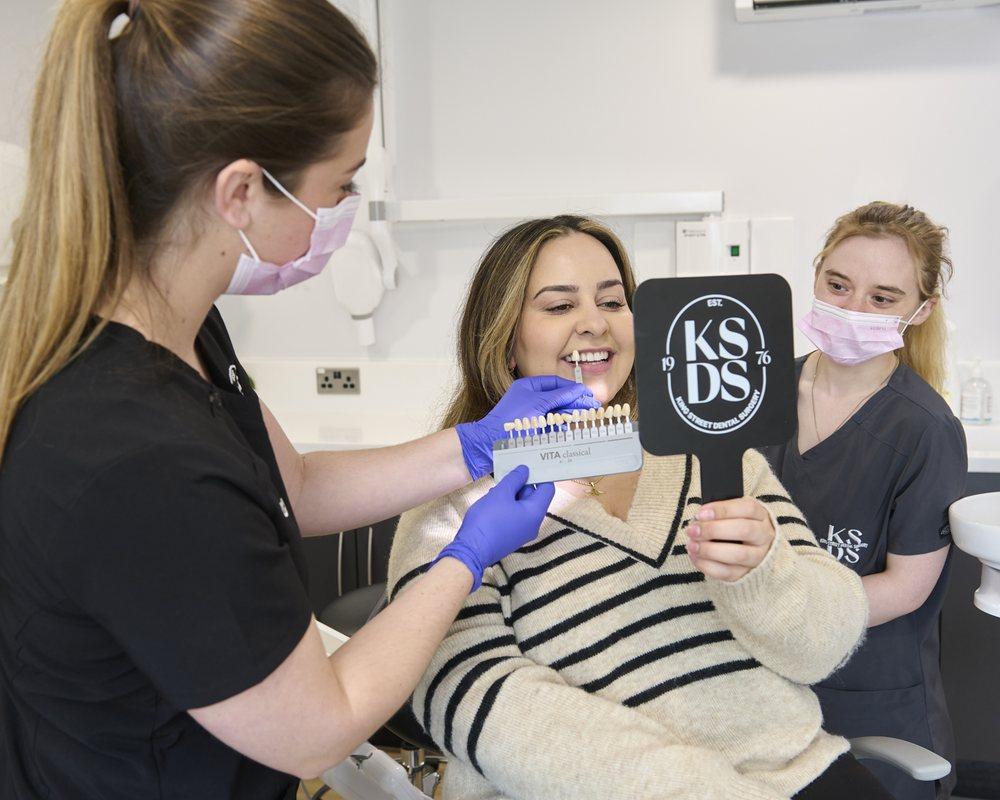
Using local anaesthetic, the tooth will be prepared and carefully reshaped to create space for the crown, whilst preserving as much healthy tooth structure as possible. At this point, a digital scan will be taken of the prepared tooth so that the dental lab can create your bespoke crown that fits perfectly. A shade match will also be recorded to ensure the crown blends seamlessly into your smile. Your dentist will construct a temporary crown that will be fixed to your tooth whilst you’re waiting for your crown to be made. (This usually takes approximately two weeks.)
3. Fitting your new crown
Once your custom dental crown is ready; it is checked for fit, colour, comfort and appearance before being securely bonded into place.
The result is a restoration designed to feel natural and function like your own tooth.
How long do dental crowns last?
Dental crowns are designed to be a long-term solution. Their lifespan depends on several factors, including:
- Oral hygiene
- Diet and lifestyle
- Bite forces
- Teeth grinding habits
- Regular dental maintenance
With proper care, many dental crowns can remain functional for well over a decade. Studies and clinical experience suggest that both Zirconia and E-max crowns can provide excellent long-term outcomes when appropriately selected and maintained.
The use of dental crowns in Smile Design
Dental crowns are not only restorative - they can also play an integral role in modern, cosmetic dentistry.
As part of a personalised Smile Design treatment plan, crowns may be used to:
- Improve the shape of a natural tooth
- Restore worn teeth
- Correct severe discolouration
- Enhance smile symmetry
- Rebuild damaged teeth
When combined with treatments such as Invisalign®, teeth whitening or composite bonding, crowns can help to achieve both a highly aesthetic smile and functional outcome.
Book a dental crown consultation at King Street Dental Surgery
If you any of your teeth are damaged, weakened or heavily-restored; a dental crown may help to protect your oral health and restore confidence in your smile.
Book a consultation if you are looking for:
- Metal-free crown options
- Natural-looking restorations
- Bespoke treatment planning
- Modern digital dentistry
- Comprehensive restorative and cosmetic care
Patient stories

Jonathan's crown and bridge experience
Book a Crown consultation today
We believe every restoration should be tailored to the individual patient, creating results that are durable, functional and aesthetically balanced.
FAQs
Read some of the most asked questions about Dental Crowns…
A crown is a custom-made restoration that covers and protects a damaged or weakened tooth; restoring its strength, appearance and overall function.
If a tooth has extensive decay, a large existing filling, cracking or significant structural damage; a crown may provide more predictable long-term protection than a filling alone. Your dentist will assess your tooth carefully during your consultation and offer their recommendations.
Neither material is universally better. E-max is often preferred for highly-visible front teeth due to its natural translucency, while Zirconia is typically chosen for back teeth because of its exceptional strength. What’s right for you will depend on your individual circumstances.
With good oral hygiene and regular dental care, crowns can often last 10-15 years - or even longer!
No, Treatment is carried out under local anaesthetic to ensure you remain comfortable throughout the procedure.
Yes - the advancements in modern dentistry mean that crowns now look incredibly realistic. Modern Zirconia and E-max crowns are carefully designed to match the colour, shape and characteristics of your natural teeth as closely as possible.
Dental crowns should be cared for just like natural teeth - with regular brushing, flossing and routine dental examinations.
Yes - crowns are commonly recommended after root canal treatment to strengthen and protect the remaining tooth structure.
Generally speaking, Zirconia crowns offer greater fracture resistance and are often preferred for patients with heavy bite forces or teeth grinding habits.
They absolutely can! Crowns can improve colour, shape, size, symmetry and overall aesthetics as part of a wider Smile Design treatment plan.
What our patients have to say
Get in touch
In need of a speedy consultation or have a question? Please don't hesitate to get in touch with us or leave a message.
We'll ensure a swift response.
- Call us on
- 01253 620552
- Email (new patient enquiries)
- hello@ksds-blackpool.co.uk
- Please note: we are unable to accept new NHS patients.
- Email (appointments for existing patients)
- appointments@ksds-blackpool.co.uk